New Exhibit, Koanbanchinemma (do you see the light (in me)), Opens in Lyman
News

Published November 24, 2025
The botanic garden is a space of conservation, creativity, and, frequently, collaboration. Koanbanchinemma (do you see the light (in me)), the exhibition which opened in Lyman Plant House on Thursday, November 20th, emphasizes these three values while adding a fourth: cultural connection.
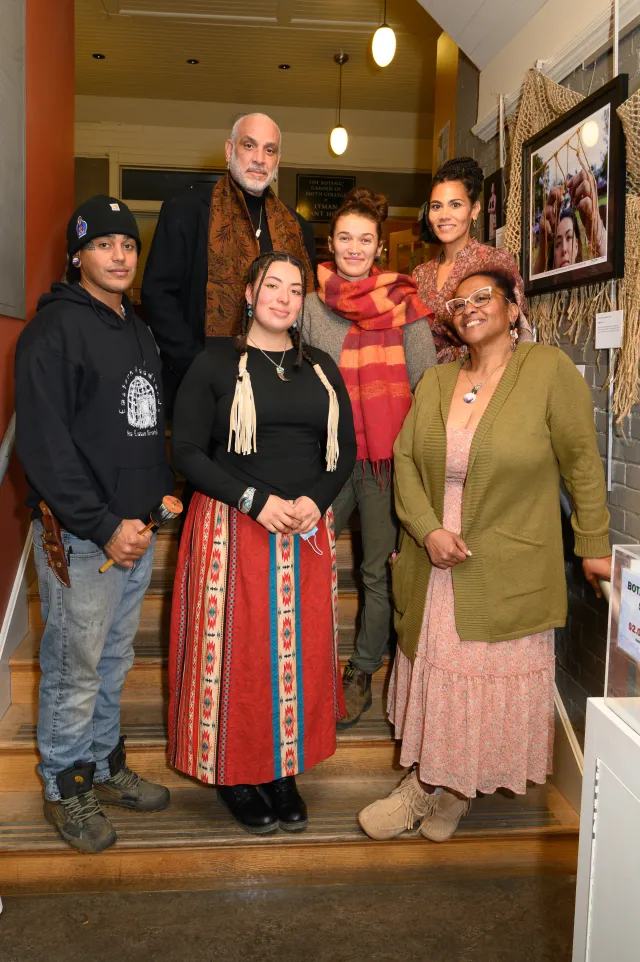
The exhibition features works from six local Nipmuc artists, cultural and land practitioners (from left to right): Andre StrongBearHeart Gaines-Roberson, Jr., Scott Strong Hawk Foster, Willow Daly and Keely Curliss (of Pequoig Farm), Kimberly Toney and Rachel Healing Willow Bayliss. It is co-curated by Toney, Coordinating Curator for Native American and Indigenous Collections at Brown University Libraries, and Sarah Loomis, Associate Director of Education at the Botanic Garden of Smith College, with support from the Smith Office For the Arts (SOFA). In featuring these works, the intent is to begin to “indigenize” the garden: to honor the Nipmuc people and their longstanding, meaningful connection to the land, invite critical reflection on the settler colonial history of botanic gardens and encourage visitors to build new relationships to the land rooted in reciprocity.
“For me, to indigenize is to open space for Indigenous epistemologies and to use them to inform how we observe, name, teach, and care for the garden. It means not just adding Indigenous content (plants, stories, labels), but allowing Indigenous frameworks to change how we see and interact with the garden and the world around us,” said Toney. This philosophy deeply shapes the exhibition, which centers these frameworks in a space that has historically devalued them.
The land that Smith College and the botanic garden now stand on is deeply important for several sovereign Indigenous nations, especially the Nipmuc. As Toney describes in the exhibition text, “Long before the establishment of the botanic garden, Indigenous peoples of the Kwinitekw (Connecticut River) Valley have been active stewards of this land, engaging in complex systems of care, cultivation, and relationship with the environment.” Smith’s campus and all of Western Massachusetts is unceded Indigenous territory; this exhibit is a recognition of that, and an acknowledgement of the garden’s position in a much longer history of environmental stewardship.
The exhibit includes a wide variety of works, from beadwork to photography. Each person involved in the project offers their own perspective related to the central theme of “indigenizing” the garden: for example, Keely Curliss, farmer at nearby Pequoig Farm, brought traditional plants into the garden. Pequoig Farm’s work centers around food sovereignty and cultural connection. “My hope in planting literal seeds in the ground here at the botanic garden is that students and visitors will realize and be reminded of our community’s continued presence and resilience in our homelands,” said Curliss.
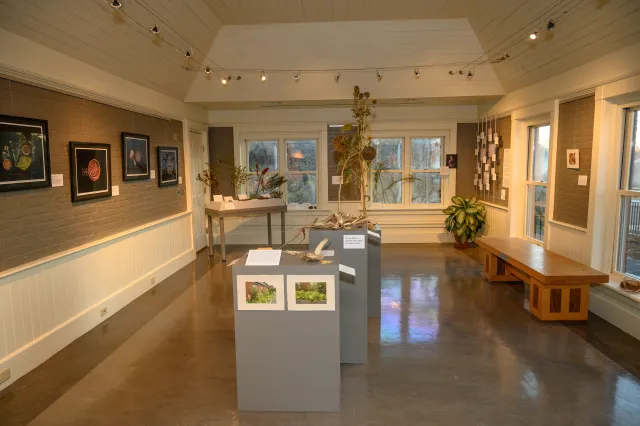
Others are bringing visual elements, such as Scott Strong Hawk Foster’s vivid photographs. Foster stated “My ethos as an Indigenous artist is to represent my family and community authentically, to record compelling images that make known the true stories of our heritage, values, and oral traditions, and to attest to how we are thriving today.” He captured the images that are being used to promote the exhibit, as well as many other powerful photos throughout the gallery. Still others, like Andre StrongBearHeart Gaines-Roberson, Jr., highlight cultural practices and traditions through their pieces. StrongBearHeart Gaines-Roberson Jr. constructed the mini-wetu and mini-mishoon in the Church Gallery. Labels are included alongside the works to highlight the process of creating these pieces using materials sourced directly from the land.
The entire exhibit is an opportunity for visitors to intentionally engage with Indigenous perspectives and knowledge. The multi-media, sensory-focused curation enables a variety of ways to think about these concepts, purposefully allowing visitors to approach it from multiple angles. “Having the people in the exhibition bring in these perspectives feels like a really wonderful intervention to the normalization of the botanical garden as the structure that it is,” said Toney. Nothing in the exhibition will be behind glass, further encouraging connection to the items displayed.
The structure of the exhibition is intended to encourage people to think in new ways, expanding a visual appreciation of nature to also include a deep reciprocal care towards it. “It hopefully brings in this indigenizing aspect of ‘you have to care for your spirit and the spirit of all things,’” said Toney. The plants displayed, many of which visitors will recognize from their own back yards, are culturally significant for a variety of reasons: sumac and wild indigo are used for dyes, goldenrod is used to treat fevers, and so on. Toney emphasized that she wants visitors to learn how to view themselves as in relationship with the land, and the more-than-human relatives that share that home.
The garden has been increasingly focused on engaging with Indigenous histories of the region, as well as place-based learning and relational thinking. The vision for Koanbanchimma was set in motion from an engagement in October of 2023 called “Rooted in Truth” led by Andre StrongBearHeart Gaines-Roberson, Jr. in collaboration with Jess Gersony’s BIO368 course Understanding Climate Change through Plant Biology and the Arts and supported by the Design Thinking Initiative. “It’s very much the result of relationship-building and collective reflection,” said Toney. In keeping with the broader work of the garden, an exhibition led by Nipmuc community members felt highly apt.
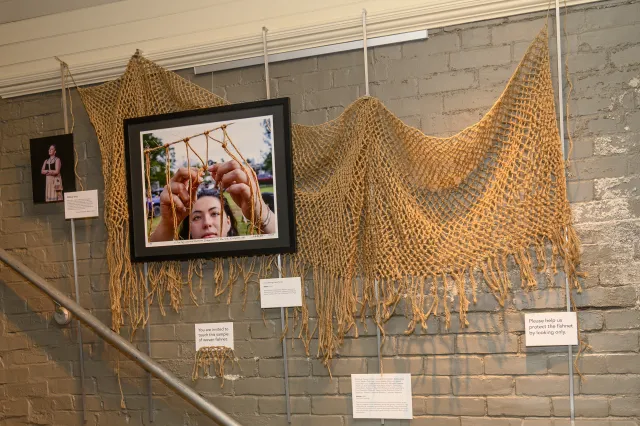
Toney explained that the form of conservation historically practiced by these institutions contrasts with indigenous methods of stewardship. “The very idea of a “botanic garden” emerged from imperial networks of exploration and extraction, where plants, seeds, and specimens were gathered from colonized lands and brought back to Europe or North America to be studied, displayed, and commodified. The removal of plants from their homelands mirrored the displacement of Indigenous peoples themselves. I think when we can understand that botanic gardens are both scientific and colonial spaces, we can then also imagine what else they might become.” There is a lot of work that must be done to repair the harm caused to both people and the land through these systems; exhibitions like this are beginning to imagine how botanic gardens can increasingly become spaces of connection rather than colonization, and how these institutions can learn from those that have cared for this land for so long.
Koanbanchinemma is the first of what will hopefully be continued collaborations between the garden and the Nipmuc community. Other examples of indigenization can be seen in different aspects of the garden, such as the community loom recently revitalized by Botanic Garden Student Educator Sophie Ramirez ’28, or the monthly “Food as Medicine” series during Student Open Hours. Toney also mentioned efforts to connect indigenous students on campus (beyond those involved with the garden) to Nipmuc mentors.
On behalf of the botanic garden, Loomis worked to help bring the exhibit together. "I’m so grateful to Kim, Andre, Scott, Rachel, Keely and Willow, for sharing their knowledge, humor, talents, and insights with us over these past months, as we worked together to envision and develop Koanbanchinemma (do you see the light (in me))," said Loomis. "Ultimately, I see this exhibition as an expression of deepening relationships. My desire is for the garden to continue to support Nipmuc folks in ways they call on us to. We will continue to grow out cedar and sweetgrass to support access to culturally significant plants, offer the greenhouses as a site of gathering and respite, lend hands during Pequoig Farm volunteer days, welcome folks back to campus for workshops and talks, and amplify work that is currently underway. I’m excited to see where these relationships take us."
Toney expressed her hope that the exhibition would impact viewers. “By engaging with Nipmuc artists and knowledge keepers, I hope they begin to see the land not as a backdrop, but as a relative, and as something that both reflects and sustains us. If visitors walk away more attuned to their surroundings and aware of their responsibilities within the web of life, then the exhibition has been a success, I think.”