Is a Mental Health Boost the Reason the Bulb Show Has Such Enduring Appeal?

Published April 8, 2026
Opening during the earliest days of March, what one might tentatively consider spring, the bulb show brings bursts of colorful flowers—and throngs of excited visitors—into Lyman Plant House. The Spring Bulb Show, a beloved tradition for more than 100 years, is the botanic garden’s biggest event of the year. This year, around 25,000 visitors came to enjoy the beautiful bulbs.
For many, the cheerful display can offer hope for better (and warmer) days ahead. The timing of the show coincides with a tough time of year for students and community members alike: Everyone is worn down from the many months of winter, and March means midterm season on campus. Is a mental health boost part of the reason the show has such enduring appeal?
Several students shared that visiting the show has a positive effect on their mood. “The bulb show makes me happy,” said Sarah Formica ’27. “We're looking at all the colors and I'm like,' I feel so grateful for this.’” Formica has a tradition of coming to the show with her friend. “We're juniors now, and we've done it every year since our first year. I think the show is just generally one of my most looked forward to events of the year.”
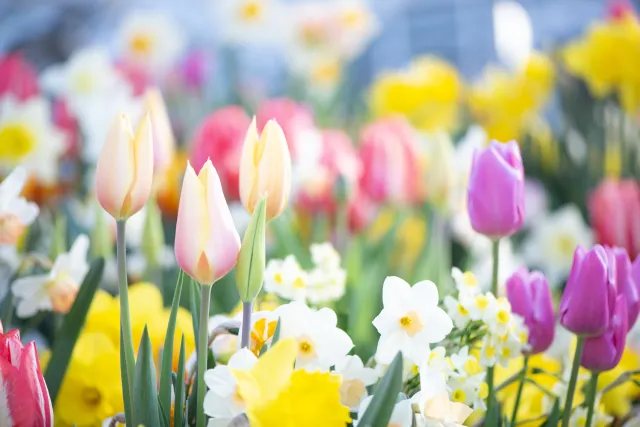
Camryn Hoffman ’28 echoed her sentiments: “Especially since flowers don't come up until April or May, I think it's nice to see a little hope, a little look towards the future. The botanic garden is also a community space… where people can come together, and look at beautiful plants… it really affects people here which makes it a really good thing to have every year.”
Winter in Western Mass can be pretty bleak and dreary. The greenhouses hold plants that cannot survive a New England winter—they can also be a lifeline for people who might feel the same.
“On days when I'm feeling like I have nothing to look forward to, I will come here for a walk or bring my book in here and sit on a bench. I definitely visit more often in the nicer weather months because I have more motivation, but the botanic garden has been there for me through some tough times in the winter,” said Formica. She said that both the show and the tradition of attending with a friend are cherished experiences, marking the transition out of a long winter. “It feels like ringing in the spring. In the winter, it's kind of hard to find things to look forward to. And this is like the first thing to look forward to that brings my mood up after a long, hard winter.”
Director of the Schacht Center for Health and Wellness Kris Evans said, “There are particular times of year that we know are statistically more difficult for people. And early spring is one of them.” While most people think of winter as being the worst period, according to Evans, spring is actually nationally considered to be a high-risk time for mental health. "What often happens is people have been so depressed and lethargic that the warmer weather gives them enough energy to act on feeling depressed.”
The Schacht Center has a wide variety of resources to support students. “The two things I think are critically important is for students to understand that the services are free, and that we don't communicate with anyone in the college about the services that are offered,” Evans said. Because the center doesn’t bill insurance, they can have a higher level of confidentiality—privacy that is especially important during this political moment. Evans also said the center has offerings that people “don’t traditionally think about,” such as a gender affirming garment library and harm reduction bags.
She encouraged students to "go back to the basics” with mental health, including spending time in green spaces. “Sometimes people think the only path of mental health is therapy. But you know, I'm an old school therapist, and there’s nothing better for me than to go for a walk in the woods. And I think we've got such a treasure over at the botanic garden.” There is strong evidence of the positive effect that green spaces like the botanic garden (albeit human-designed) have on mental health; Evans said “the research on this is unequivocal.” Her main advice for anyone struggling was to reach out to Schacht, either in person or over the phone.
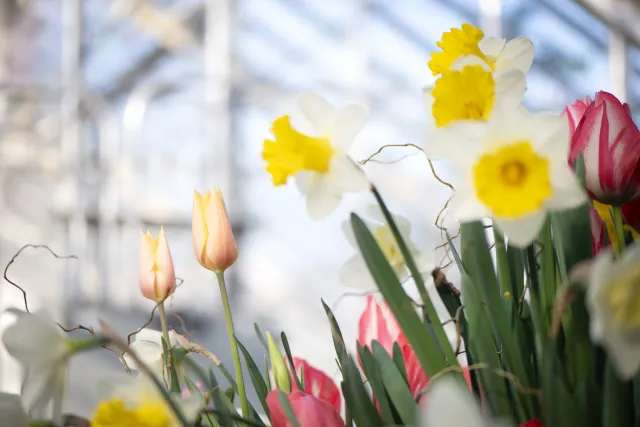
Evans attends the show every year with her colleagues, noting that the show is important for the staff’s mental health as well, and has taken her 21-year-old son to the show since he was little. “I mean, I am a psychoanalyst, right? That's how I'm trained. I would say on an unconscious level, there's something really powerful about this idea of something that's ritualized in the community that's about rebirth, and hope… and taking that in with other people around you.”
The bulb show is a high-effort, resource-intensive endeavour. The botanic garden staff plan and work for months to bring the show to fruition. “As an educational botanic garden, most of what we do serves a curricular purpose, with the exception of the bulb show which is no longer tied to botany classes,” said Greenhouse Horticulturist Caitlin Robertson. “But, it is so important for the community.” Robertson, who began working at the garden this past December, led the design and assembly of this year’s show along with support from botanic garden student workers. Two students also designed art installations that were featured in the show, which is one way the garden weaves in educational experiences into the show.
“Going through the show, I heard so many people say things like, ‘Oh, we needed this. I wish we had this in February.’ I think just being around plants and growing things really does a lot for people in the winter.” She said that working on the show also helped her personally cope with the strain of winter.
After more than a century, the bulb show continues to bring value to the Smith community and beyond. In Robertson’s opinion, it is precisely the focus on beauty that makes it so meaningful. “There’s a lot of terrible things happening [in the world]. I think having a space to just connect with plants, and connect with people and be insulated from that, even just for a little bit, is an important part of self care. I think the bulb show could count as one of those spaces to be reminded of the beautiful things in the world.”
When the show closes, the garden invites students to cut bouquets and bring some beauty home with them. The leftover bulbs then get shared with community partners, including farms, nonprofits, and religious centers in Northampton and the surrounding area.
“I hope that people recognize the work the botanic garden is doing every day, like putting this bulb show together,” said Evans “What a generative act that is for the mental health of the entire campus community. It's a really cool thing.”