At the Final Food as Medicine of the Year, Cultural Memories and Relationships with Plants are Rekindled
News

Published May 4, 2026
Throughout campus, the rosy petals of the Japanese cherry blossoms are taking their turns revealing the beauty of spring and hinting at the summer to come. Students anxiously conclude their finals as the cuisines they left at home trace the distance of continents across their minds.
As the final season of the semester slowly strolls by, the botanic garden wraps up their Food as Medicine series—a monthly event designed for and with students, which features a plant and a dish derived from that plant—and reflects on the enriching semester these gatherings brought. Food as Medicine aimed to kindle the relationships between students and the plants they consume that make up staples of cuisines far in distance, but close to their hearts.
“So many of us consume many of the plants that are included in the Food as Medicine series, but we don't necessarily know, intimately, much about those plants,” said Manager of Engagement Anjali D’Souza, who brought this series to life over the course of this academic year.
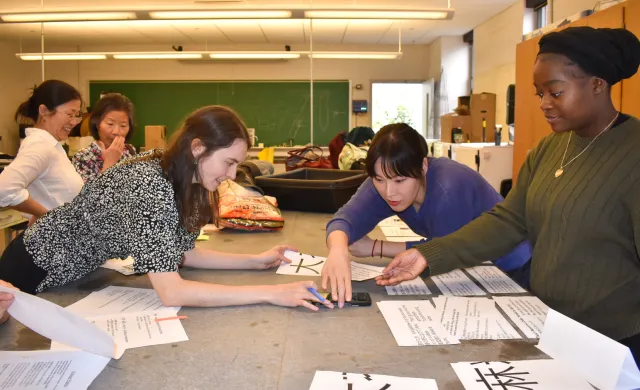
From humble, sparsely-attended beginnings to lines out the door of Lyman, Food as Medicine has spotlighted jackfruit, papaya, Camillia, and rice—among others. These plants, which are economically significant to humans and invaluable contributors to ecological stability, span a variety of different cultures and continents with scents and textures that students may have long forgotten—or so they thought.
“I'm looking forward to continuing to make Food as Medicine a recurring event in which people have awakened in them a sense of what they do know inside their bodies… what memories might be evoked whenever one tastes a plant that is familiar to them, but had gotten lost or forgotten—due to markets, movement, forced migration, dispossessions, and cultural displacement,” said D’Souza.
Looking back on previous Food as Medicine events, it has done just that. D’Souza recounts,
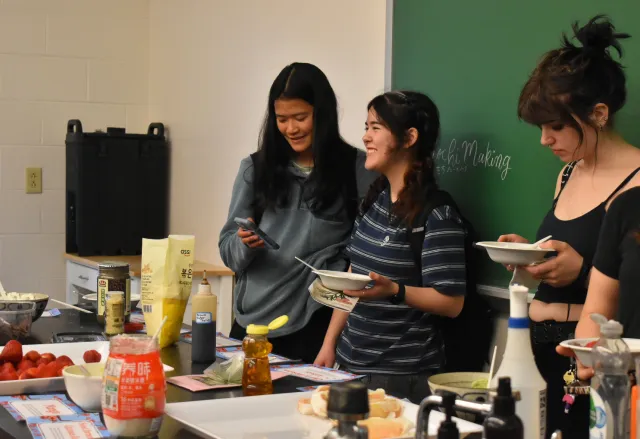
“One of my favorite memories that really was touching for me was when we had our rice focus in December and we had students write reflections on post-its and somebody shared that they hadn't had suman in two years… and that eating it at the event really was kind of soul nourishing.”
Suman is a sticky rice dish made with coconut milk and glutinous rice— that's just one of an ubiquitous category of kakanin, common rice-based sweets in the Philippines.
“I actually made that suman,” D’Souza said. “We had taken and washed banana leaves from Palm House. I had sealed them on the stove, which my mom taught me to do. I hand tied all of those suman, and steamed them in an Instant Pot. And so that note was particularly special to me.”
Though typically partnering with student organizations, such as EKTA, PAiA, SEASA, or the co-op Hopkins House, the botanic garden partnered with the East Asian Languages and Cultures (EALC) department in the final Food as Medicine event to highlight strawberries, yuzu, rice, and cherry blossoms. This event focused on spring festivals and celebrations in China, Japan, Taiwan, and the Koreas.
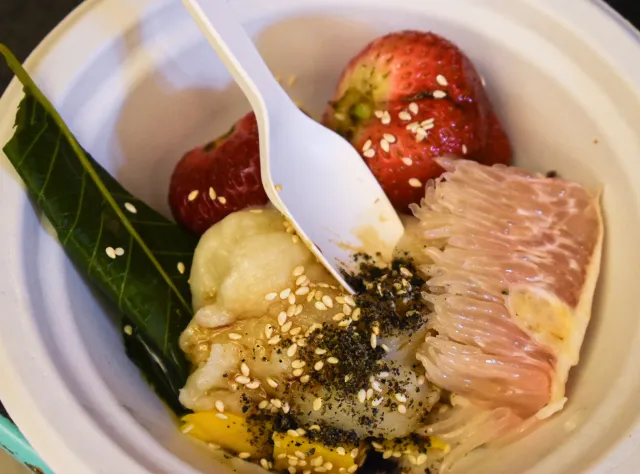
During the event, the smell of fragrant teas from the tea blending workshop wafted through the air as students waited in a line stretching past the botanic garden back entrance in anticipation of the mochi making workshop. All of the mochi provided were hand made in-house by the EALC department, including student volunteers. Korean and Japanese poems (in translation and in original characters) about rice cakes and landscape were hidden in the scenic greenhouse gardens for students to find during a creative scavenger hunt.
All of these activities culminated into an evening in which students were able to celebrate East Asian cultures through the plants that are at the heart of these dishes and thus their peoples. “The sense of community sharing, belonging and multi-species kinship surpasses my wildest dreams,” said D’Souza.
The Food as Medicine series will kick back up in the 2026-27 academic year, with continued collaboration with student orgs. If you’re interested in co-hosting, reach out soon.